

Earlier this year I had the privilege of sitting with the Praxis leadership and hearing Andy Crouch's articulation of why we need to focus on "influence" rather than "impact."
Andy's concern is valid: if we define impact using physics—force applied over time—then we're measuring coercion, not transformation. And he's right that the Kingdom doesn't advance through force.
But here's where I respectfully disagree: impact doesn't have to mean force.
Impact, properly understood, is about the transformation in people, systems, or cultures resulting from sustained, intentional action over time. It's measured by a change in meaningful outcomes and the degree to which an organization is responsible for that change.
This is what we’re seeing as the Christian impact investing and philanthropy ecosystem gathers momentum. As we’ve worked across the Christian impact ecosystem this year—from foundation leaders to frontier market entrepreneurs—one truth keeps surfacing: lasting transformation doesn't happen through coercion, wealth, or charisma. It happens through relationships.
Forces like power and money are inherently coercive. They can produce compliance, but not transformation. They can change behavior temporarily, but they can't change hearts. And when the power or money runs out—and it always does eventually—the change evaporates.
Relationships work differently. They don't coerce; they invite. They don't demand; they sacrifice. They don't extract value; they create it through mutual flourishing.
This is why the early Church, with no political power, no wealth, and no institutional backing, outlasted the Roman Empire. This is why the abolition movement, built in prayer meetings and sustained by covenantal friendships, eventually toppled the entire economic system of slavery. This is why the civil rights movement, rooted in church communities practicing beloved community, transformed America in ways legislation alone never could.
The pattern is consistent: movements driven by sacrificial love outlast empires built on force.
So as Andy beautifully articulates, long-term change does come through friendship and fellowship. But it doesn't mean we need to throw out the impact "baby" with the "bathwater." We just need to measure the right kind of impact—transformation driven by love, not coercion.
Walk into any impact investing conference or nonprofit strategy session, and you'll hear the same language: outcomes, scalability, return on investment, measurable results.
These aren't bad things. Numbers matter. Outcomes matter. Data matters.
But here's what we've learned at Kingdom Impact: the most transformative impact happens when we measure relationally, not just transactionally. This doesn't mean abandoning metrics—it means developing better ones. Metrics that capture not just what happened, but the relational dynamics that determined whether those results represent lasting transformation or temporary change.

The impact measurement field has made tremendous progress in capturing outcomes and tracking metrics. But we've learned something critical: the metrics we choose and how we gather them matters as much as the data itself. True Kingdom impact measurement begins with relationship—not as a soft add-on to "hard data," but as the foundation that shapes what we measure and how we measure it.
This relational foundation shapes everything—from which metrics we prioritize to how we gather data to how we partner with organizations. We believe impact measurement should be both rigorous and relational, both quantitative and qualitative, both data-driven and relationship-centered.
We don't just extract data through surveys and reports. We gather metrics through ongoing relationships with investors, leaders, and organizations—ensuring our measurement tools reveal true transformation, not just what's easy to count.
Our approach to measuring human flourishing is grounded in the biblical concept of shalom—the flourishing that comes when relationships are made whole. Drawing from Brian Fikkert's work, Becoming Whole, we understand that Kingdom impact happens through the reconciliation of four critical relationships:
These relationships aren't abstract concepts—they're measurable realities. Even secular research from Harvard on human flourishing and studies on trust point to the power of restored relationships.
What makes the Kingdom Impact approach distinctive is recognizing that Christ Himself modeled this relational path to transformation. In the wilderness, Jesus rejected coercive power, accumulating wealth, and leveraging charisma. Instead, He chose faithfulness, truth, and obedience—building the Kingdom through relationships of love.
This same love becomes the driving force in redemptive businesses, generous economies, and transformed communities. When we measure Kingdom impact, we're documenting how Christ's love, lived out through His people, restores dignity and brings wholeness to broken places.
True Kingdom impact is relational and transformational, not transactional or coercive.

We're not suggesting that traditional metrics don't matter. Revenue, reach, jobs — these are important indicators. But they're incomplete without understanding the relational context that determines whether those numbers represent genuine transformation or just activity.
The question isn't data vs. relationships. It's whether our data captures the relational dynamics that actually drive lasting change.
Here's what this looks like practically:
An investor might track not just financial returns, but whether investee leaders are growing in spiritual maturity. Whether they're becoming more whole, or more fragmented under the pressure of growth. Whether their organizational culture is becoming more trusting, or more fearful.
A business might measure not just profit margins, but employee flourishing. Whether people are bringing their full selves to work. Whether relationships with suppliers are characterized by partnership or exploitation. Whether the company's growth is requiring the degradation of any of the four relationships.
A charity might assess not just how many people they served, but the quality of those serving relationships. Whether beneficiaries are treated as partners or projects. Whether the organization is creating dependency or cultivating dignity.
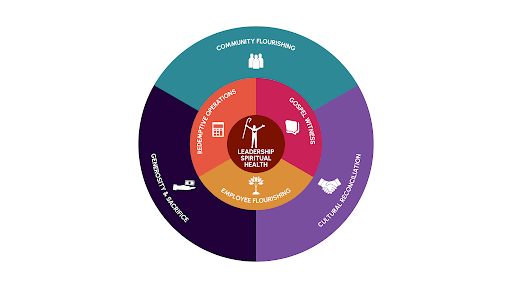
The Christian Impact Framework
Measuring relationships isn't about replacing quantitative data with warm feelings. It's about developing rigorous indicators of Kingdom impact including Christ-centred human flourishing that complement traditional metrics — things like trust levels within teams, redemptive operations in business, patterns of mutual sacrifice vs. extraction in partnerships, and whether programmes don’t just reduce material poverty but improve social, relational and spiritual well-being too.
This is why we just invested in building a master database of spiritual impact metrics—validated indicators drawn from dozens of projects and ongoing research. It's also why we're supporting the development of the Christian Impact Framework with detailed goal and outcome definitions that help organizations articulate what Kingdom impact actually looks like in their specific contexts.
And it’s why we’re leaning into conversationally-gathered data analyzed through validated frameworks as well. AI holds much promise in the area of analysing qualitative data at scale.

In the wilderness, Jesus faced a choice about how the Kingdom would advance. Satan offered Him shortcuts—political power to coerce nations, material wealth to buy allegiance, spectacular signs to wow the crowds.
Jesus rejected all three.
Instead, He chose a different path: faithfulness, truth, and obedient love. He built the Kingdom not through force, but through relationships that restored what was broken. Twelve disciples. Tax collectors and sinners. Women and outcasts. People who had been reduced to categories—poor, unclean, unworthy—were invited back into relationship with God and one another.
The early Church followed this same pattern. With no political power, no institutional wealth, no celebrity leaders—just communities practicing sacrificial love—they transformed the Roman Empire from within.
Two thousand years later, that relational movement has shaped more lives than any empire, ideology, or institution in human history.
This is what Kingdom impact looks like: not force applied over time, but love lived out through relationship.
As we enter the season of Advent, when we remember God's ultimate act of relational transformation—entering our brokenness as Emmanuel, God with us—we're reminded that the Incarnation itself was God's rejection of coercive power in favor of redemptive relationship.
The Kingdom doesn't advance through the forces the world understands. It advances through the force the world most needs: Christ's love, poured out through His people, restoring dignity and wholeness one relationship at a time.
That's the impact worth measuring. And it's the only kind that truly lasts.